New set of questions

| skdjlskd | ||||
Test the color changing and text editor.
Questions that have been asked.
For further inquiries, please contact the Parcel Section at 0 2271 6848. Thank you.
You must submit the application letter first. The HR department will review it based on your faculty and major. 4. Are there any fees for accepting interns? Answer: There are no fees. 5. What are the application submission hours? Answer: We accept applications during regular office hours. If you have any further questions, please contact the HR department at 02 2716000 ext. 6404.
Please contact our staff at 081 8712856 (Mr. Suksan).
Details, criteria, and qualifications for contractors can be found on the website of the Department of Treasury, www.cgd.go.th.
Details, criteria, and qualifications for contractors can be found on the website of the Department of Treasury, www.cgd.go.th.
You can register with the Department of Treasury. For more information, please contact 02271 0000 ext. 6847, Procurement Section.
You do not meet the eligibility criteria. If you have any questions, please contact the Human Resources Department at 022716805.
1. The government sector, through the National Water Resources Office (ONWR), is the main agency implementing water conservation projects. Contact: Chuthamas Building, 89/168-170 Vibhavadi Rangsit Road, Talat Bang Khen Subdistrict, Lak Si District, Bangkok 10210. Tel: 0 2554 1800 Fax: 0 2521 9140 Email: onwr@onwr.go.th 2. The Department of Water Resources no longer implements water conservation projects, but still provides support with materials such as posters, stickers, and water-saving buttons for government agencies to help conserve water. These can be obtained from the Water Planning and Efficiency Improvement Division, Water Management Bureau, 7th Floor, Department of Water Resources Building. Tel: 02 271 6000
Thank you for your suggestion. We will forward your idea to the relevant department.
Dear Ms. Sutharine Rithaiwattana, The laws governing the work of the Department of Water Resources are primarily those related to official conduct, as follows: 1. Civil Service Act B.E. 2551 (2008) 2. Administrative Procedure Act B.E. 2534 (1991) 3. Administrative Procedure Act B.E. 2539 (1996) 4. Act on Confidentiality and Tortious Acts of Officials B.E. 2556 (2013) 5. Administrative Court Establishment Act and Administrative Procedure Act B.E. 2542 (1999) 6. Act on Facilitating Government Permit Issuance B.E. 2558 (2015) 7. Public Procurement and Government Supplies Management Act B.E. 2560 (2017). In addition, there are specific laws related to the mission of the Department of Water Resources, as follows: 1. Ministerial Regulation on the Division of Government Agencies within the Department of Water Resources, Ministry of Natural Resources and Environment B.E. 2545 (2002) 2. Ministerial Regulation on the Division of Government Agencies within the Department of Water Resources... Ministry of Natural Resources and Environment (No. 2) B.E. 2551 (2008) 3. Announcement of the Revolutionary Council No. 58 B.E. 2515 (1972) 4. Water Resources Act B.E. 2561 (2018) Nattapong Na Phatthalung, Senior Legal Officer
Dear Sergeant Major Paiboon Anantrang, Regarding your inquiry, please be informed that "water resource linkage" refers to the establishment of a water network system for systematic water management, utilizing existing and new water sources to ensure that all water sources have access to water for various activities in each area. If you require further information, please contact the relevant officer at 0-2271-6000 extension 6626 (Mr. Kitcha). Sincerely,
Please submit a written request as follows: To the Director, Water Management Division, Department of Water Resources.
Take bus number 74, 77, or 38 from the side of Phramongkutklao Hospital and get off at the entrance of Soi Phahonyothin 7. For inquiries, please call 022716000.
Regarding the use of standard village water supply system specifications from the Department of Water Resources, the contractor is required to comply with the following specifications: If the reinforced concrete steel diameter is 12 mm or larger, only SD30 quality deformed reinforcing steel (rebar) should be used. However, if, as explained by the relevant agency, SD30 quality deformed reinforcing steel is unavailable on the market, and according to engineering principles, SD40 quality deformed reinforcing steel can be used without affecting the structural integrity, but the construction must adhere to the specifications, and the existing specifications only require SD30 quality deformed reinforcing steel, the contractor must amend the construction contract in accordance with the Public Procurement and Supply Management Act B.E. 2560 (2017) and the Ministry of Finance Regulations on Public Procurement and Supply Management B.E. 2560 (2017).
The Department of Water Resources is no longer responsible for major river basins and their tributaries. The National Water Resources Office is now the agency responsible for this.
In urgent cases, coordinate with local authorities to request support for water storage equipment or develop a village-wide project to seek support from the Environmental Fund, the Office of Natural Resources and Environmental Policy and Planning, and the Department of Water Resources. Support should also include relevant technical documents on water crises, water conservation, etc.
For inquiries, please contact 022716000 ext. 6847, Department Secretariat Office, Procurement Division.
Type Qa soil is an alluvial soil, typically found at river deltas, with a mixture of gravel and clay. A high proportion of gravel reduces water retention, while a higher proportion of clay minimizes seepage. Generally, soil seepage and evaporation are normal for reservoirs. However, if the soil in the reservoir construction area has acceptable seepage limits—i.e., seepage is less than the rate at which the reservoir is filled during a year of rainfall—then a reservoir can be built.
The Research, Development and Hydrology Division of the Department of Water Resources does not have rainfall monitoring stations installed in the Bangkok metropolitan area. Data for that area can be obtained from the Meteorological Department.
For inquiries, please contact 022716000 ext. 6805, Department Secretariat Office, Human Resources Management Division.
For inquiries, please contact 022716000 ext. 6805, Department Secretariat Office, Human Resources Management Division.
For inquiries, please contact 022716000 ext. 6805, Department Secretariat Office, Human Resources Management Division.
For inquiries, please contact 022716000 ext. 6805, Department Secretariat Office, Human Resources Management Division.
For inquiries, please contact 022716000 ext. 6617, Department Secretariat Office, Human Resources Management Division.
A river is a large natural waterway. In scientific terms, it's a general term referring to all natural water currents, including smaller streams and canals. Ponds are deep channels in the soil or rock used to hold water. Pools or lakes are still water bodies, usually smaller than lakes, and can be natural or man-made. Naturally occurring ponds may be in floodplains as part of a river system, or they may be separate basins. Ponds may be shallow and contain aquatic plants and animals that thrive in wetlands. The types of organisms in a pond are generally determined by a combination of factors. A canal is a waterway or stream, either naturally occurring or man-made and connected to a river or sea. In Thai, the term "mae naem khu klong" (แม่น้ำคูคลอง) is used to collectively refer to waterways of various sizes, with rivers being the largest, and canals and ditches being smaller. Canals often connect rivers to other rivers. Huai (ห้วย) is a basin that retains water flowing from mountains. Nong (หนอง) is a basin that retains water flowing from mountains. Swamps are large areas with a large volume of water. It may cover several villages and sub-districts and features diverse natural environments, such as Bueng Boraphet and Bueng Chawak lakes, among others. There are also canals and small waterways dug to channel water from irrigated fields into or drain water from rice paddies.
Dear Dr. Hasan Etae, The Regional Water Resources Office 8 has received your complaint. Please be informed that the responsibility for resolving this issue lies with the Department of Groundwater Resources. Therefore, please contact the Groundwater Resources Office, Region 12, Songkhla directly. The address and contact number are attached. Groundwater Resources Office, Region 12 (Songkhla), 439/10 Moo 2, Songkhla-Koh Yo Road, Phawong Subdistrict, Mueang District, Songkhla 90100. Tel: 0-7433-0225, Fax: 0-7433-0225, Email: www.bgrr12@dgr.mail.go.th
Rainfall data in southern Thailand over the past 30 years is available from individual stations listed on the website of the Research, Development and Hydrology Division. http://ishydro.dwr.go.th/
The removal of sediment in tap water generally begins with pumping raw water from surface areas and adding alum and/or lime to remove sediment, as surface water contains a high concentration of sediment that causes it to clump together. The water then undergoes sedimentation and filtration. After this purification process, the treated water is stored, chlorine is added for disinfection, and the water is then distributed to consumers. If the produced tap water is of poor quality, it's necessary to check if the water has undergone these processes and to inspect the raw water for contamination so that the appropriate filtration media can be selected for removal.
For inquiries, please contact 022716000 ext. 6805, Department Secretariat Office, Human Resources Management Division.
According to the Royal Decree on River Basins, B.E. 2564 (2021), which river basin does it not belong to?
Dear Mr. Paiboon Homthong, Regarding your request for support for a solar-powered water distribution system project submitted through the Department of Water Resources website, the Department of Water Resources would like to clarify that we are very pleased to undertake the project to develop a solar-powered water distribution system for your village. However, the Department of Water Resources requires additional information regarding the location of your village so that the Regional Water Resources Office responsible for your area can conduct a survey to assess the readiness for project implementation. Therefore, we request that you complete the project request form through the “Request for Water Resource Development Project” menu on the Department of Water Resources website or access it directly at [link/website]. https://dwr.go.th/projectrequest.php
Upon investigation, no water resource projects under the aforementioned name were found in the Department of Water Resources' database. The Department of Water Resources' mission is to implement projects for the conservation, restoration, development, and management of water resources to meet the water needs of rain-fed agricultural areas, serve as a source of water for consumption, production, and agriculture, prevent and mitigate drought and flooding, alleviate water-related hardship for the public, maintain the balance of ecosystems and wetlands, and support royal initiative projects. Information on the Department of Water Resources' annual funding for water resource conservation, restoration, development, and management projects can be found on their website. http://division.dwr.go.th/bwrpp1/index.php/2019-10-29-11-09-07 For more information regarding the Annual Budget Act, please contact the Water Resources Policy and Planning Office, Project and Budget Analysis Division, at 02 271 6000 ext. 6326.
For postal addresses to request a transfer to the Department of Water Resources, please address the envelope to: Human Resources Management Division, Department of Water Resources, 180/3 Rama VI Road, Phaya Thai Subdistrict, Phaya Thai District, Bangkok 10400. (P.S. Please include the transfer request form on the envelope.)
Khlong Luang Basin is located in the northeastern part of Chonburi Province, with an area of approximately 1,930 sq km. Its headwaters are in Khao Ang Kradean. The river flows through the plains from the south to the north, passing through Bo Thong District and Phanat Nikhom District into the Bang Pakong River. It has a length of approximately 90 km. There are plains on both sides of the canal where rain-fed rice is cultivated. Khlong Luang, a sub-basin of Khlong Luang (1604), comprises the area of 5 districts and 1 sub-district in Chonburi Province, namely Phan Thong District, Phanat Nikhom District, Bo Thong District, Nong Yai District, Ban Bueng District, and Ko Chan Sub-district. https://tiwrm.hii.or.th/web/attachments/25basins/16-bangpakong.pdf
Industrial water is not primarily intended for public use. Industrial plants do not primarily supply water to the public, therefore, a concession is not required under Regulation 58.
The Department of Water Resources wishes to clarify the following regarding the standard designs for village water supply systems: 1. The published standard designs for village water supply systems are intended to facilitate local administrative organizations in using them as supporting documentation for water supply system construction contracts and as part of the contract itself. The Department of Water Resources is responsible for providing technical and academic support and consultation to ensure the use of these designs adheres to sound engineering principles and serves their intended purpose. 2. Any local administrative organization or agency wishing to use these standard designs must strictly adhere to the terms and conditions for permission to use the standard designs for village water supply systems, available on the website of the Water Management Division, Department of Water Resources. 3. Cost estimation must be conducted based on actual costs specific to each location and in accordance with the government's guidelines for calculating standard construction costs. The attached cost estimates are for convenience and guidance only and do not include external electrical connection and extension costs, nor do they include water source construction costs. Some items, such as raw water pumps and the procurement and laying of raw water pipes and equipment, are hypothetical quantities. The procurement and installation of water supply pipes and equipment, etc., must be cost-estimated according to the specific details of the location. Note: The cost estimate file for the large-scale surface water village water supply system has also been sent to the Non Muang Subdistrict Administrative Organization via email.
The Department of Water Resources has sub-offices located in the provinces as follows: 1. Water Resources Office 1, Lampang Province; 2. Water Resources Office 2, Saraburi Province; 3. Water Resources Office 3, Udon Thani Province; 4. Water Resources Office 4, Khon Kaen Province; 5. Water Resources Office 5, Nakhon Ratchasima Province; 6. Water Resources Office 6, Prachinburi Province; 7. Water Resources Office 7, Ratchaburi Province; 8. Water Resources Office 8, Songkhla Province; 9. Water Resources Office 9, Phitsanulok Province; 10. Water Resources Office 10, Surat Thani Province; 11. Water Resources Office 11, Ubon Ratchathani Province. For more information, please visit www.dwr.go.th, under the "Links to Internal Agencies" menu.
The construction of weirs involves collaboration among various agencies. For village water supply systems, please contact the Water Allocation Division, Department of Water Resources, during office hours.
Frequently Asked Question 1
Mr. Opas Thaworn, Mr. Wesarat Sophondirekrat
Mr. Teerachun Boonsit
Mission: 1. Develop policies and plans to promote integrated and systematic cooperation in water resource management at national and international levels. 2. Promote, support, and enhance the capacity of river basin organizations and networks. 3. Conserve, restore, develop, improve the efficiency, and maintain the ecological balance of water sources and wetlands. 4. Develop knowledge, information systems, and establish standards for integrated water resource management and early warning systems for application by all sectors, as well as support the development of water systems for consumption.
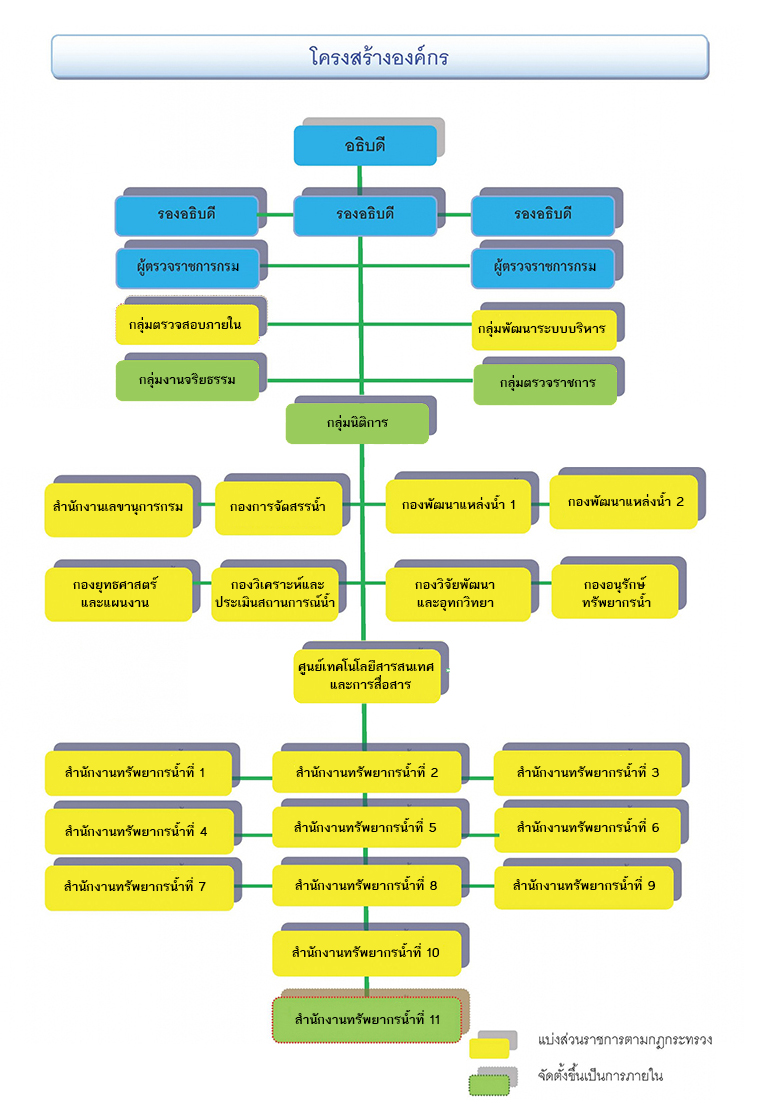
The Department of Water Resources is a government agency under the Ministry of Natural Resources and Environment. Its mission is to advise on the formulation of policies, plans, and measures related to water resources; manage, develop, conserve, restore, and oversee the control, supervision, coordination, monitoring, evaluation, and problem-solving concerning water resources; develop academic expertise, set standards, and transfer technology related to water resources at both the national and river basin levels for unified and sustainable water resource management. Its duties and responsibilities are as follows: (1) To be the lead agency in advising on policies, master plans, and measures for the management, development, conservation, restoration, utilization, and problem-solving concerning water resources; and to supervise and coordinate their implementation. (2) To determine guidelines for the preparation of action plans for the management, development, conservation, and restoration of water resources through public participation. (3) To study, research, develop, conserve, and restore water resources. (4) To monitor and evaluate the management of water resources according to policies, master plans, action plans, and measures established at both the national and river basin levels. (5) To develop a database system and information network concerning water resources. (6) To determine or recommend improvements or amendments to laws, rules, and regulations concerning the management of national water resources. (7) To promote, disseminate, publicize, and transfer technology related to water resources, and to campaign for understanding among organizations and stakeholders. To cultivate awareness of the value and importance of water resources (8) to coordinate cooperation with foreign countries and international organizations on water resources (9) to promote, support and provide technical advice, standards and regulations on water resource management to government agencies and local administrative organizations (10) to perform any other operations as prescribed by law as the authority of the Department or as assigned by the Ministry or the Cabinet. In conjunction with the Head of the National Council for Peace and Order's Order No. 46/2017 dated October 25, 2017 and Order No. 2/2018 dated January 22, 2018, establishing the National Water Resources Office to be the main policy agency for the management of the country's water resources by transferring the missions and personnel of the Department of Water Resources in the work of recommending policies and plans for water resources in the overall national context, the work of preparing the national water resource management action plan, water resource management at the cross-basin level, coordinating cooperation with foreign countries and international organizations on water resource management, water resource management, including monitoring and evaluation, and performing duties as the secretary of the National Water Resources Committee to the National Water Resources Office. This includes the Water Resources Act B.E. 2561 (2018), which stipulates that the Department of Water Resources has duties under Chapter 1 Water Resources, Chapter 4 Water Allocation and Use, Chapter 5 Drought and Flooding, Chapter 6 Conservation and Development of Public Water Resources, and Chapter 8 Civil Liability in cases of damage to public water resources.
Call 1310, press 5.
180/3 Soi 34, Rama VI Road, Phaya Thai, Phaya Thai, Bangkok
Published in the Royal Gazette, Volume 135, Section 122 G, pages 44-83, dated December 28, 2018. (For more details, please visit http://www.dwr.go.th, main menu: Useful Information, and sub-menu: Laws.)
According to the Water Resources Act B.E. 2561 (Section 4)-1, the term "water" means atmospheric water, surface water, groundwater, and seawater.
“Water resources” means water, public water resources, headwaters, reservoirs, irrigation canals, floodplains, whether naturally occurring or man-made, and other things used for water management, and includes water from international water sources and foreign water sources that Thailand may utilize.
3 types. Details from the Water Resources Act B.E. 2561 (2018), Section 41.
Type 1 water resource use includes the use of public water resources for subsistence, household consumption, subsistence agriculture or livestock farming, household industries, ecosystem preservation, traditional customs, disaster relief, transportation, and small-scale water use.
The Prime Minister, with the approval of the National Water Resources Committee, shall take necessary actions to alleviate the drought situation.
Hydrological Research and Development Division, Research, Development and Hydrology Department, Department of Water Resources.
Yes, according to the Department of Water Resources regulations regarding requests for hydrological and meteorological data, B.E. 2560 (Clause 7).
For inquiries, please contact 022716000 ext. 6805, Department Secretariat Office, Human Resources Management Division.
The process for applying for water resource development project support consists of: 1. Filling out the details on the Department of Water Resources website, including name, surname, national ID number, contact telephone number, email address, selecting the province where the project is requested, and providing a brief description of the application. 2. Once the responsible officer has received your application, they will contact you to request further details. 3. You can track the progress of your application on the Department of Water Resources website by entering your national ID number.
Businesses wishing to apply for concessions to operate water supply businesses in any of the eight activities can do so by submitting a letter of intent according to the respective activity, along with supporting documents, as follows: 1) Businesses in Bangkok should submit to the Department of Water Resources, located at 180/3 Rama VI Road, Soi 34, Samsen Nai Subdistrict, Phaya Thai District, Bangkok 10400; 2) Businesses in other provinces should submit to the Provincial Office of Natural Resources and Environment.
1) For small-scale water supply systems, please submit the following documents and evidence: 1. Application form for a water supply concession (Form SP.1). Submit one original and two copies. 2. In the case of a limited company or limited partnership, submit three copies of the certificate of registration of the legal entity from the Department of Business Development, issued no more than 6 months prior to the application date, and which must include the objective of operating a water supply business. 3. In the case of authorization, prepare a power of attorney document with affixed stamp duty according to the Revenue Code. Submit one original and two copies. Submit three copies of the house registration and national identification card of both the grantor and the grantee. 4. Copy of national identification card. and a copy of the applicant's house registration certificate, 3 sets. 5. Preliminary information for applying for a water supply concession (Form SP.2): Submit 1 original and 2 copies. 6. Water supply business plan and concession area plan, 7 sets. 7. Simplified map, 7 sets. 8. Water supply site plan, 3 sets. 9. Water distribution pipe plan, 7 sets. 10. Building plans and specifications for the water treatment plant, 3 sets. 11. Details of the process, steps, methods of production, and methods for removing contaminants in raw water to meet the water quality standards set by the Ministry of Natural Resources and Environment, 3 sets. 12. Details of the water supply system design calculations, including calculations of water demand, pumping system, water production system, disinfection system, and water distribution piping system, along with a certification letter and a copy of the professional license of the engineer who performed the calculations, 3 sets. 13. Water quality analysis results of the raw water source used for water production. The analysis must be conducted according to the water standards set by the Ministry of Natural Resources and Environment (currently using the standards according to the announcement of the Department of Health). Regarding the standards for potable water quality, the following documents must be submitted: 13 sets of documents; 14. Documents proving consent to use the land for the construction of the water supply system (if the land belongs to another person) – 3 sets; 15. Copy of the land title deed or permit from the authorized person in the area where the concession is requested – 3 sets; 16. Water tariff analysis report and water meter maintenance fee analysis report – 3 sets; 17. Letter notifying the water supply expansion plan from the Metropolitan Waterworks Authority, Provincial Waterworks Authority, or local administrative organization – 3 sets; 18. Other documents and evidence, such as a copy of the groundwater use permit (if using groundwater) – 3 sets; a copy of the surface water use permit (if using surface water and the water source belongs to another person) – 3 sets; cross-sectional drawings of the river or reservoir; plans showing the area of the reservoir or water storage pond; normal water level, maximum water level, minimum water level; and a raw water volume calculation report from an engineer to confirm the adequacy of the raw water source. (In case surface water is used as the raw water source) 3 copies of the factory operating license; 3 copies of the factory operating license.
Application fees are as follows: Concession application – 2,000 baht; Concession extension application – 1,000 baht; Concession renewal application – 2,000 baht; Concession transfer application – 1,000 baht; Water rate/meter maintenance fee adjustment application – no fee; Concession cancellation application – no fee; Water sales application – no fee; Inspector's fees – a fixed rate of 5 baht per cubic meter of water delivered at full capacity for one hour, with a minimum payment of 50 baht per year.
You can find this information on the Department of Water Resources website, or the Water Situation Analysis and Assessment Division website, Department of Water Resources. Select the "Water Situation" menu tab.
Following Her Royal Highness Princess Maha Chakri Sirindhorn's journey by waterway on September 20, 1994, to inspect the condition of Khlong Saen Saep and visit the people along its banks from Bangkok to Chachoengsao Province, a distance of over 72 kilometers, which brought widespread joy to the people, the Cabinet approved on September 18, 2001, that September 20 of each year be designated as National River, Canal, and Stream Conservation and Development Day. This initiative aims to raise awareness and promote appreciation for rivers, canals, and streams among all sectors – government, private, and the public.
The video can be viewed at the website https://division.dwr.go.th/wrcrd/index.php/2022-05-24-02-07-30/2022-05-24-02-41-01
Stakeholders from small water sources who come together to engage in group activities with a common objective, and who are recognized or acknowledged by government agencies and local administrative organizations.
1) To fairly allocate and share water among group members. 2) To maintain and preserve water resources in good and efficient condition. 3) To act as a representative in contacting and coordinating with other agencies. 4) To foster a sense of love and appreciation for water resources and the activities created among members. 5) To encourage members to use water economically and efficiently. 6) To facilitate meetings and exchanges of ideas between members and government officials on academic matters and other activities, both on and off-site.
1) Hold stakeholder meetings to explain project details, listen to and exchange ideas on project development. 2) Select a water user group executive committee by recruiting members and then electing a president and executive committee members. 3) Define the roles and responsibilities of the executive committee, including establishing rules and regulations regarding water use, care and maintenance, reporting problems and obstacles, holding regular executive committee meetings, coordinating with relevant government agencies and members, and mediating disputes in the water source area. 4) Define the roles and responsibilities of water user group members, which include complying with rules and regulations, assisting in the care and maintenance of the water source, and providing information and suggestions to the executive committee.
1) Training: Government agencies, private sector organizations, and local administrative organizations should promote and support training and study tours for water user groups. 2) Activities to strengthen water user groups: 2.1) Analyze the needs of water user groups in each area, such as fishing, agriculture, and household industries, to find ways to increase their income from their products. 2.2) Design activities for public benefit, such as weed removal, landscape improvement, tree planting, and cleaning water sources. 2.3) Design activities to promote unity on important days or traditions related to water resources, such as National River, Canal and Stream Conservation and Development Day, Songkran, and Loy Krathong.
Water in the atmosphere, surface water, groundwater, and seawater.
Water, public water resources, headwaters, reservoirs, irrigation canals, floodplains, whether naturally occurring or man-made, and other things used for water management, including water from international and foreign water sources that Thailand may utilize.
Water in water sources used or reserved for public use, or that by its nature may be used jointly by the public, shall include rivers, canals, waterways, swamps, groundwater sources, lakes, internal waters, territorial seas, wetlands, other natural water sources, water sources constructed or developed by the state for public use, international water sources within Thailand that can be used by the public, irrigation waterways under the Irrigation Act, and groundwater under the Groundwater Act.
A condition in which the quantity, flow rate, or water level of water continuously decreases to the point that it may affect the lives of people, animals, and plants in a particular area.
A condition in which the volume, flow, or level of water increases continuously, or surges, or occurs suddenly, potentially affecting the lives of people, animals, and plants in a particular area, but excluding tides which are normal natural phenomena.
Wetlands refer to lowlands, floodplains, marshes, swamps, and water sources, both natural and man-made, that are permanently or temporarily flooded or stagnant, and that are both flowing and freshwater, brackish, and saltwater. This also includes coastal areas and marine areas where, at low tide, the water depth does not exceed 6 meters.
Projects aimed at preserving and restoring wetlands to their original natural state, considering ecosystem, physical, human use, and socio-economic dimensions.
The project focuses on improving and developing wetlands to be better than their current state, considering the dimensions of ecosystem, physical aspects, human use, and socio-economic factors.
The River Health Index (RHI) refers to a methodology developed from the Asian Development Bank (ADB) framework to assess the sustainability of water resource development and management. This concept, known as Water Security, refers to the ability to access the required quantity and quality of water for production, sustenance, and health, with acceptable levels of water-related risk. In Thailand, there is currently no government agency that has established a standardized framework and methodology for assessing river health indices. Therefore, the assessment is based on the "Manual on Framework for River Health Assessment in Thailand" (May 2018), a report presented by researchers at the Asian Institute of Technology (AIT) with support from the Thai Water Partnership (TWP), CGIAR’s Program on Water, Land and Ecosystem (Greater Mekong), and Australia Aid. This framework comprises two main components: the river itself and its overall ecosystem. While the objectives of assessing river health indices are similar, the characteristics and ecosystems of each river differ, thus requiring different variables for evaluation.
The overall value of wetlands lies in their role as water sources, reservoirs for rainwater and runoff, protection against saltwater intrusion, prevention of coastal erosion, trapping of toxins, capture of sediment and minerals, as a source of natural resources and products, and as a habitat for diverse plant and animal species. They are crucial for ecology and nature conservation.
February 2nd of each year marks the day when the international community drafted and signed the "Convention on Wetlands of International Importance, Especially as Habitat for Waterfowl," in Ramsar, Iran. This convention is known as the Ramsar Convention. Thailand became a party to the Convention on Wetlands on May 13, 1998, as the 110th country to sign it.
The Convention on Wetlands of International Importance, commonly known as the Ramsar Convention, is an international agreement promoting the conservation and wise use of wetlands. It is the only international treaty focusing on a single ecosystem (information from www.ramsar.org). The Convention on Wetlands of International Importance, or Ramsar Site, is named after the location where the convention was adopted on February 2, 1971, in Ramsar, Iran. This convention is an intergovernmental agreement that establishes a framework for international cooperation in the conservation of wetland habitats, with the objective of conserving and preventing the loss of wetlands worldwide, which must be managed for wise use. The convention came into force in 1975, provided that seven countries became parties to it. Thailand became the 110th party to the Convention on Wetlands on September 13, 2008, proposing the Khuan Khisien Swamp wetland as an internationally important wetland or Ramsar site. One of the key obligations is to propose wetlands with suitable ecological characteristics and that meet the criteria of the Convention for inscription as wetlands of international importance or Ramsar sites (List of Wetlands of International Importance).
172 countries
Member states have pledged to: – Use all wetlands wisely; – Designate wetlands of international importance for inclusion in the “Ramsar Sites”; – Promote transboundary wetland cooperation and other collaborations.
For information regarding the Convention on Wetlands, please contact the Water Resources Conservation Division, Department of Water Resources, at 02271 6000 ext. 6735.
The Ramsar Convention Secretariat has designated February 2nd of each year as World Wetlands Day to raise awareness about wetlands. This day also marks the anniversary of the Convention on Wetlands, which came into force as an international treaty in 1971. The international community drafted and signed the "Convention on Wetlands of International Importance, Particularly as Habitat for Waterfowl," in Ramsar, Iran. This convention is known as the Ramsar Convention. Thailand became a party to the Convention on Wetlands on May 13, 1998, as the 110th country to sign it.
Bird migration routes are defined paths that connect breeding grounds with wintering areas, guiding them as they travel across vast landscapes. These routes are shaped by a combination of geographical features such as coastlines, mountains, and open bodies of water.
The regional international cooperation project in Asia, under the Ramsar Convention framework, focuses on the East Asia-Australia Migratory Flight Route, one of the nine major migratory bird routes worldwide. This route extends from Eastern Russia (Russian Federation) and Alaska (USA) southward through East and Southeast Asia to the Commonwealth of Australia and New Zealand, covering 22 countries. Its objectives are: 1. To develop a network of internationally important migratory bird routes for conservation, drawing on successful lessons from the Asia-Pacific Migratory Bird Conservation Strategy; 2. To support communication, education, and public awareness of the importance of migratory bird species and their habitats; 3. To support research and monitoring along migration routes, enhance knowledge, and promote information exchange on migratory bird species and their habitats; 4. To strengthen the capacity of natural resource managers, decision-makers, and stakeholders at the local level in managing migratory bird species and their habitats; and 5. To develop migration routes, particularly for important species and habitats, to improve the conservation status of migratory bird species. Thailand was invited by the chairperson of the Asia-Pacific Migratory Waterbirds Conservation Committee (MWCC) to join the MWCC committee in 2001.